
Polymarket Backtest Accuracy Reached 95.32%
We compared pm-hftbacktest with live limit-order strategy results across 547 Polymarket BTC 5-minute Up/Down markets.
A profitable backtest is easy to produce. The harder question is whether it can reproduce live trading.
We tested that question across 547 Polymarket BTC 5-minute Up/Down markets where a live limit-order strategy actually triggered an order. The comparison covered 17 days, from June 24 to July 10, 2026.
| Metric | Result |
|---|---|
| Live–backtest outcome agreement | 95.32% |
| Cumulative profit curve correlation | 98.59% |
| Backtest profit overestimation | 10.45% |
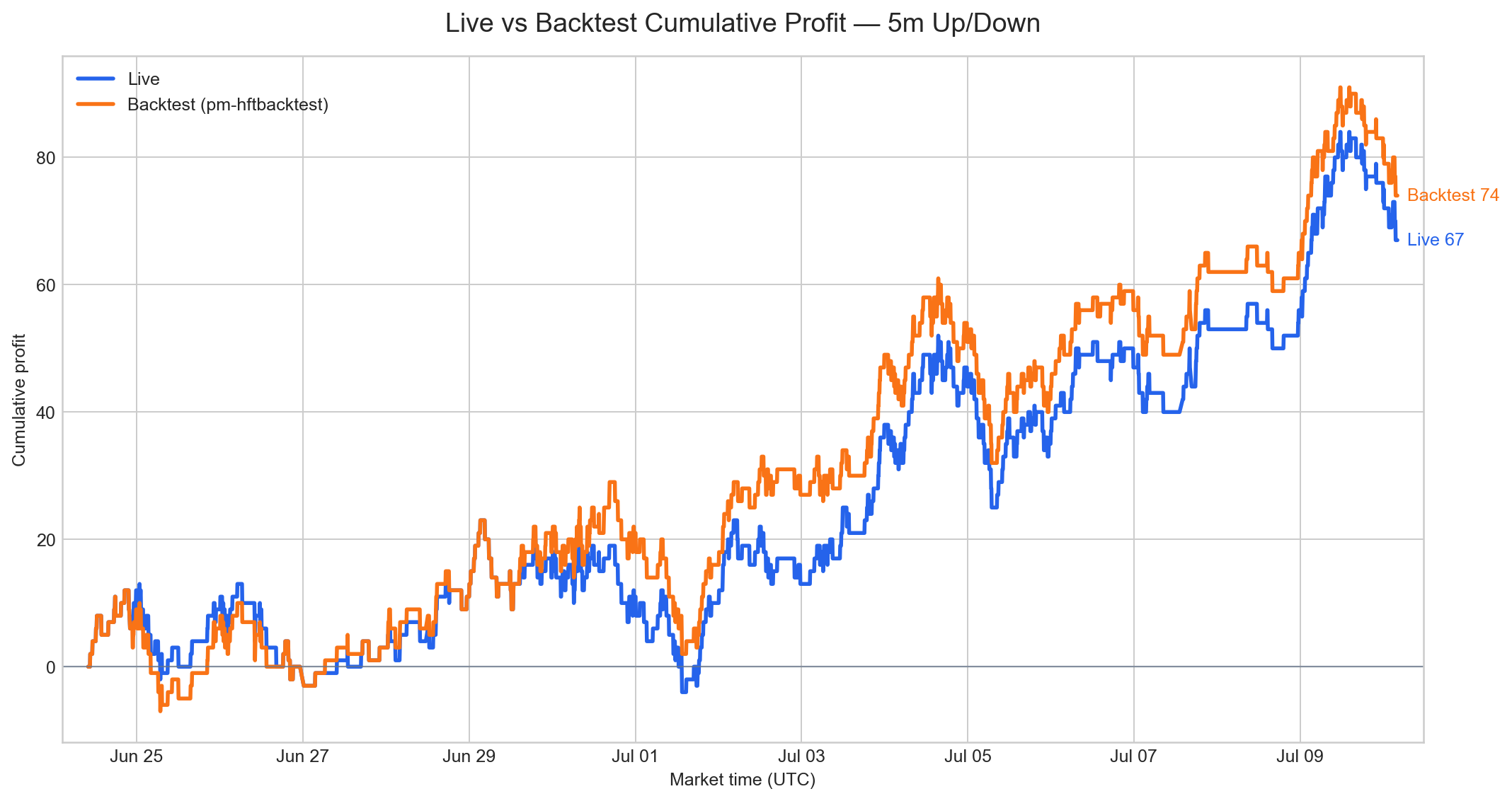
The two cumulative profit curves followed a similar path, but the backtest remained more optimistic. At the end of the test, cumulative profit was 74 in the backtest and 67 in live trading.
How we compared the backtest with live trading
The strategy used limit orders and could trigger at most once in each market. Every market was classified as one of three outcomes: profit, zero return, or loss.
We created one outcome sequence from live trading and another from the pm-hftbacktest simulation, then compared the two sequences market by market. The reported accuracy is the percentage of markets with matching outcome classifications; it is not a strategy return.
Why the backtest overestimated live profit
The main difference came from execution latency. A fill that appears available in a simulation may disappear before a live order reaches and is processed by the market. As a result, the backtest captured more fill opportunities than the live strategy.
The result shows that pm-hftbacktest reproduced the live strategy's market-level outcomes and cumulative profit direction closely, while still overstating the profit available under live execution. More precise latency and order-arrival modeling should help narrow that gap.
Backtest framework: mileswangs/pm-hftbacktest. Data source: PMData.